
Outdoor & Remote First Aid,
Including Lone Worker Adaptations
A 20 hour assessed blended course in Outdoor and Remote First Aid with additional adaptations for applying this training to yourself when working alone, more than 10 minutes from your colleagues, or are the only trained first aider in the group.
The only course we offer Nationally

Outdoor & Remote First Aid, Including Lone Worker Adaptations
A unique course, designed in collaboration with Industry, to answer the question;
“How do we ensure we meet our UK legal requirements for the provision of First Aid to our employees when they are working on data collection and research alone, in small groups or abroad?”
FAW Cornwall was approached by industry to develop a new course as the Training Manager, Calum, has worked regularly on collecting geological data in the field alone or in small groups, leading fieldtrips, and working in collaboration abroad. The problem was identified during a routine check through an organisations Health & Safety procedures and the question of First Aid provision arose. All UK based organisations are required to ensure there is suitable First Aid provision for all of it’s employees but this is difficult to guarantee when staff work alone, in small groups or are working in small international groups.
The easiest solution to guarantee that all UK requirements are met is to train all employees that work in the field, both in the UK and abroad, in Outdoor & Remote First Aid and also how to apply this training on themselves. This led to a new type of First Aid course, where trainees consider and practice how to adapt their Outdoor First Aid training if they had to use it on themselves or to instruct an untrained person how to help.
From this the ‘Outdoor & Remote First Aid, Including Lone Worker Adaptations’ course was created.
Origin of the Course
This course includes all the content of Outdoor & Remote First Aid, ideal for anyone working in locations where professional medical assistance may not be immediately at hand such as working in the field, hiking or leading field trips. This aspect of the course requires 15 hours of teaching time and is assessed through both practical exercises and written assessment. Passing this course means a trainee is a qualified first aider in Outdoor & Remote First Aid. Should a trainee not manage to pass all aspects of the assessment they will be issued with a certificate of attendance instead.
Due to the special circumstances of scientific field research an extra 5 hours of training has been added to include extra adaptations to cover scenarios where a person may be working alone some of the time and may need to apply the outdoor & remote first aid training to themselves, rather than to another person.
This is a blended course, combining online training in advance with 2 days in the classroom. Since many organisations have stressed the difficulty of finding time for their staff to attend training for 3 days, as it is far more difficult to schedule this around other work commitments, the course runs as a blended version with only 2 days in the classroom. Courses are usually taught on either Monday & Tuesday or Thursday and Friday to keep Wednesday free for cleaning and resetting equipment, and to travel to the next course.
Description
This course is ideal for all persons who work or recreation outdoors in situations where they may be time-distant from professional medical assistance. In particular, this course is designed for persons who conduct scientific research in the field and may at times work alone, or without other trained first aiders nearby, and will therefore initially need to conduct first aid on themselves before further help arrives. This includes situations such as;
Working alone. This may include collecting samples in the field, field mapping, surveying a site or waiting in an animal hide to record behaviour. As soon as you are not in sight of other people, even when not particularly remote, you may need to apply your own initial first aid until assistance arrives.
Working in a scattered group. If your colleagues are more than 10 minutes away, allowing for terrain, you may need to apply your own first aid until they reach you. Be aware, in difficult terrain someone may be in sight, but still quite time distant from you, and in a medical emergency a situation can get significantly worse in just a few minutes without trained first aid assistance.
Working with unknown colleagues. When collaborating in a team you may not be sure who has first aid training or to what standard. This is particularly relevant when working with international teams, who’s required level of first aid training may be significantly different to the UK. Being able to apply your own first aid if necessary, and understanding the correct modern procedures should other first aiders have outdated methods, is incredibly important.
Being the only First Aider. Small research groups commonly only have one trained first aider for logistical reasons. But what if you are the first aider and you are the one that gets injured? Being able to apply your own first aid, and to clearly direct other members of the team how to administer first aid, is an extra level of safely when working in small groups.
Who is this training for?
What’s Included in the course?
Full detailed First Aid training manual.
CPR. Full CRP training with practice and assessment on a CPR Manikin
AED Training. Full training with practice and assessment in the use of an AED (Automatic External Defibrillator) so you don’t need an additional course
First Aid Equipment. Standard Outdoor & Remote first aid equipment, optional and advanced first aid equipment, First Aid Needs Assessments, how to design a first aid kit for your requirements
Shock. Recognition and treatment of shock and hypovolemic shock
Primary & Secondary Surveys. Detailed training and assessment on primary and secondary surveys on both conscious and unconscious casualties, checking response levels, SAMPLE, head-to-toe assessment
Airways & Breathing. Training and assessment in airway management, breathing difficulties, collapsed lung, flail chest, drowning, choking, abdominal thrusts, asthma, the recovery position
Bleeding Control. Practical training and assessment in the control of bleeding including the use of dressings, wound packing, haemostatic dressings, direct pressure, torniquets, dressing imbedded objects, handing amputations
Breaks and other physical injuries. Full range of different types of injury including broken bones, dislocations, head & spinal injuries, soft tissue injuries, internal injuries, chest injuries, eye injuries
Splints. Understanding different types of splint and their application. Practical training and assessment in the use of splints
Illnesses. Full range of illnesses including heart attacks, strokes, seizures, diabetes, anaphylactic shock
Burns. Including burns, scalds, chemical burns, electrical burns
Bites. Human, animal, snake & other venomous bites, Australian Pressure Immobilization Technique, spider bites, insect stings, scorpion stings, tick bites, Lyme disease
Environmental. Hypothermia, frostbite, heat stroke, heat exhaustion, dehydration, sunburn, avalanches, lightning, drowning
Evacuation. Directing emergency services to the scene, helicopter landing procedures, winchman procedures, visibility, signalling, flares & smoke, location options, moving a casualty
Lone Worker Adaptations. All subjects mentioned here also include adaptations on how these procedures can be adapted to be used by a person on their own
Prices
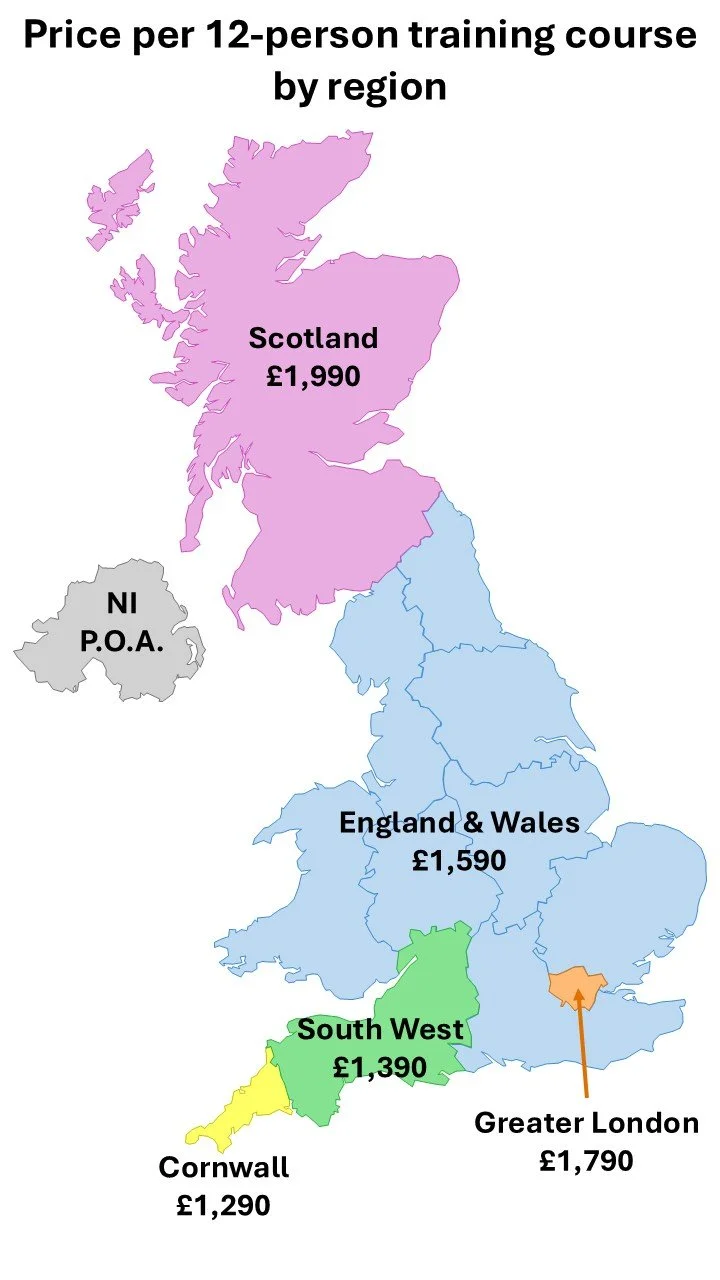
We charge a fixed price per 12-person course including all expenses, except a training venue if it needs to be hired . The price excludes VAT and depends on your region as shown by the map on the left and listed below:
Cornwall - £1,290 ex VAT (from £108 per person)
South West - £1,390 ex VAT (from £116 per person)
England & Wales - £1,590 ex VAT (from £133 per person)
Greater London - £1,790 ex VAT (from £150 per person)
Scotland (Mainland) - £1,990 ex VAT (from £166 per person)
The price assumes you have your own suitable training room on your premises. If not, we will happily hire a training venue for you and charge you at cost. Typically, venues can be hired from £60 to £120 per day.
FAW Cornwall requests a 25% deposit to secure a booking, and the remaining 75% is billed once the course has been completed.
Is there a way to get a discount?
Yes, we are keen to give you the best possible price, but are hampered by travel and accommodation costs. By lowering these costs we can pass on this discount.
Here are examples of discounts that we are able to offer. In most examples only one of these will apply (not multiple discounts) and we will always give you the bigger discount:
If you have more than 12 people to train we could run two courses for you in the same week. The second course will be charged at the Cornwall price saving a total of £700 in Scotland, £500 in London, £300 in England & Wales or £100 in the South West.
Alternatively, if you partner up with another organisation in the same region and we can do both your courses in the same week we can give both of you a discount. In Scotland you would each save £350, save £250 each in London, £150 each in England & Wales or £50 each in the South West.
You can make an enquiry, or book a course, by getting in touch with us. You can use the quick form by clicking the button below, or email us directly to the training manager, Calum Beeson, if you prefer at calum@fawcornwall.co.uk
Course Enquiries & Booking